Find dealers that merit review
Benchmark cost per unit, repair frequency, and repairs per unit. Investigate persistent deviations within comparable product and operating populations.

Identify risk earlier.
Focus every audit.
Strengthen dealer accountability.
Connect dealer benchmarking, AI-powered evidence review, and claim scoring to reduce avoidable warranty cost—before payment and throughout the audit lifecycle.
Benchmark cost per unit, repair frequency, and repairs per unit. Investigate persistent deviations within comparable product and operating populations.
Process repair orders, technician labor time cards, and parts inspection records to surface inconsistencies and missing support.
Apply evidence-based claim scoring and adjudication before payment. Use audit findings to improve future decisions and dealer guidance.
A high-cost dealer is a review candidate. It may also serve a harder-working fleet, a different product mix, or vehicles affected by a quality issue.
| Benchmark signal | What the auditor should investigate | How Circuitry.ai supports the decision |
|---|---|---|
| Cost per unit Warranty expense ÷ eligible units | Product mix, age, utilization, repair severity, and local labor rates | Identify cost outliers within defined peer cohorts and drill into contributing claims. |
| Repair frequency Repair events per exposure period | Repeat visits, repair effectiveness, campaigns, and emerging field issues | Surface recurring repair patterns for dealer review or quality escalation. |
| Repairs per unit Repair events ÷ unique serviced units | Multiple operations, repeat component replacement, and concentrated VIN histories | Connect claim histories to identify clusters requiring evidence review. |
| Labor & parts patterns | Extra labor, overlapping time, duplicate operations, unusual part quantities | Compare claimed work with repair narratives, time cards, and inspection evidence. |
| Evidence & policy exceptions | Missing support, inconsistent identifiers, approvals, and return obligations | Score evidence completeness and highlight policy questions for an auditor. |
Methodology above is a recommended configuration approach, not a claim that every OEM uses the same criteria or thresholds. Repair frequency and repairs per unit must be defined separately to avoid double counting.
Extract complaint, cause, correction, identifiers, dates, mileage, parts, and labor operations. Compare the repair story with the claim and applicable policy.
Reconcile technician, job, and timestamps. Flag overlaps, missing punches, and unexplained differences between claimed and documented work.
Bring inspection reports, return records, and available photos into the review. Check consistency with the claimed failure and required return process.
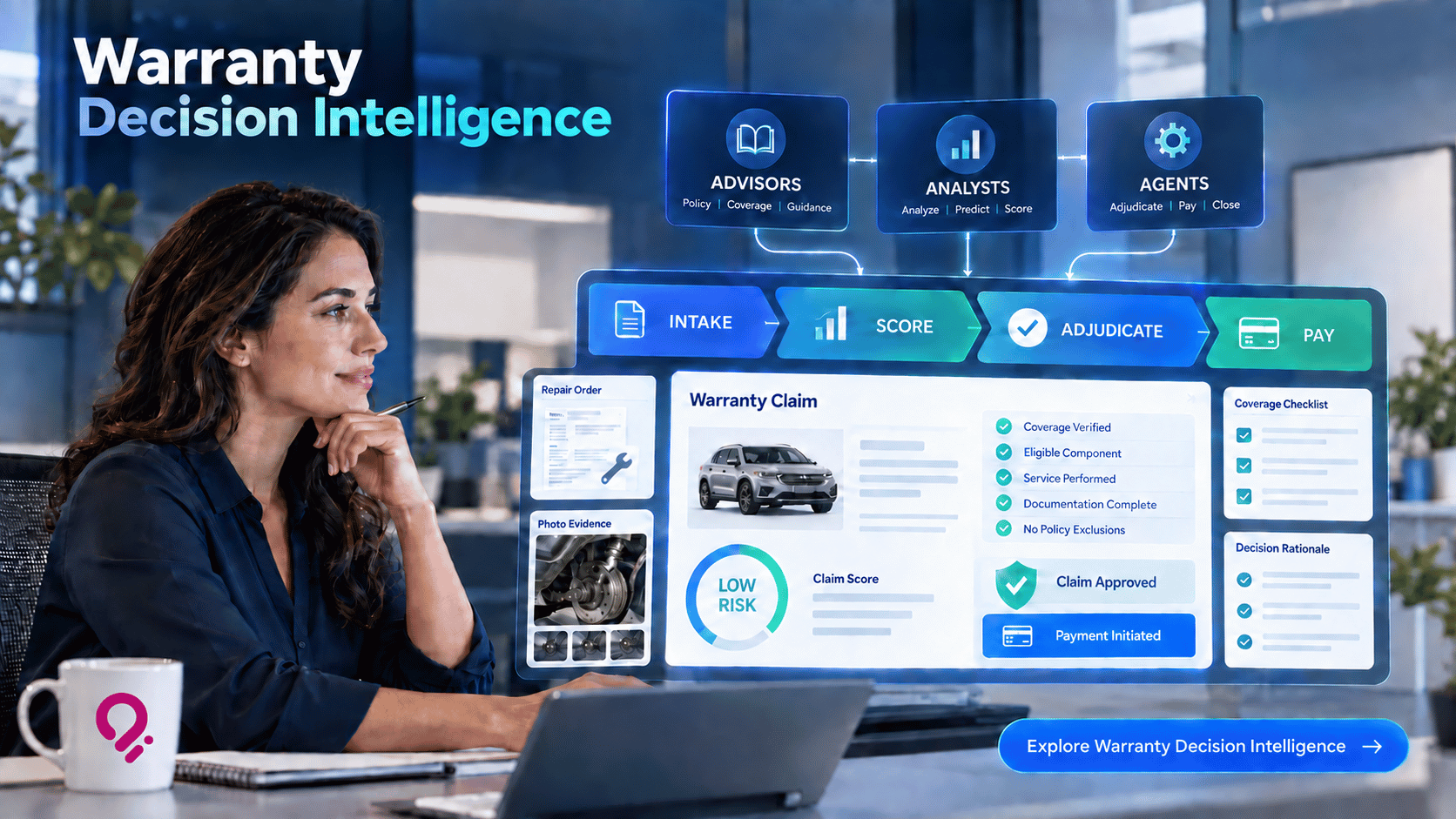
A dealer score prioritizes review. Claim scoring identifies potentially unsupported amounts. The auditor confirms the finding, policy basis, and supported debit scope.
Document extraction and image analysis support auditor judgment. AI cannot establish a physical part’s condition without suitable inspection evidence; missing information is a request for review, not proof of misconduct.
Keep the trail from benchmark to evidence, finding, dealer response, and final disposition.
Rank dealer signals, validate cohorts, and select a risk-based claim sample plus a random control sample.
Process records, reconcile evidence, and document claim-level policy exceptions.
Request clarification, capture dealer responses, and route findings for authorized approval.
Track final outcomes, deliver coaching, and feed validated findings into upstream controls.
Recommended operating model. Configure systems, approval routes, notices, and deadlines for your OEM’s policies and applicable jurisdiction.
Use specific evidence and policy references. Distinguish a documentation gap from unnecessary repair, overbilling, or suspected fraud.
Request missing evidence and support self-review or coaching where appropriate. Retain the dealer’s response with the final decision.
Limit proposed chargebacks to supported findings. Apply authorized review, current requirements, and appeal processes before financial action.
Configure controls for relevant contracts and current local rules; audit windows, notice, appeal rights, and chargeback restrictions vary. Do not extrapolate a targeted sample to the full population without an approved, applicable methodology.
| Public example | Documented approach | Decision intelligence opportunity |
|---|---|---|
| Ford Historical policy record [1] | Staged counseling, self-review, warranty review, and audit follow-up; abnormal performance can prompt escalation. | Monitor persistent deviations and prioritize evidence review before escalation. |
| Ford California board record, 2025 [2] | Allegations can trigger an investigation and warranty study before a formal audit. | Keep allegations distinct from validated findings and connect investigation evidence. |
| General Motors Historical court findings, 2004 [3] | Elevated warranty expense prompted dealer self-reviews before an expense review; labor and parts-retention issues featured in findings. | Connect cost signals with time records, parts records, and dealer correction. |
| Cross-brand audit practice Independent specialist [4] | GM expense, Chrysler POPPS, and Ford 126 reports inform high-expense RO selection; random RO review is another option. | Combine targeted review with a control sample to evaluate missed risk. |
Examples establish public precedents, not current OEM audit playbooks. Detailed current selection formulas and thresholds are often not public. No OEM endorsement is implied.
Track substantiated-finding rate, false positives, risk coverage, and missed issues in random samples.
Measure document preparation time, claims reviewed per auditor, evidence completeness, and audit cycle time.
Separate pre-payment corrections, proposed debits, approved chargebacks, collected amounts, and appeal reversals.
Set a baseline and matched comparison. Avoid double counting prevented cost and later recovery. Benefits depend on scope, evidence availability, and adoption.
Request a demo of Circuitry.ai’s Warranty Decision Intelligence.
Explore your dealer benchmarking, repair-order evidence, technician time records, parts inspection, and pre-payment controls.
No. It prioritizes review. Claim-level evidence, applicable policy, dealer response, and authorized approval determine the final action.
Circuitry.ai supports integration with existing warranty systems. Scope data access, document sources, scoring outputs, and decision writeback during implementation.
Start with one region, dealer cohort, product line, or repair category. Agree peer groups and policy rules, validate findings with auditors, and measure against a baseline before expanding.